
Video editor
Multi-track timeline, transitions, titles, colour, subtitles and export to MP4.
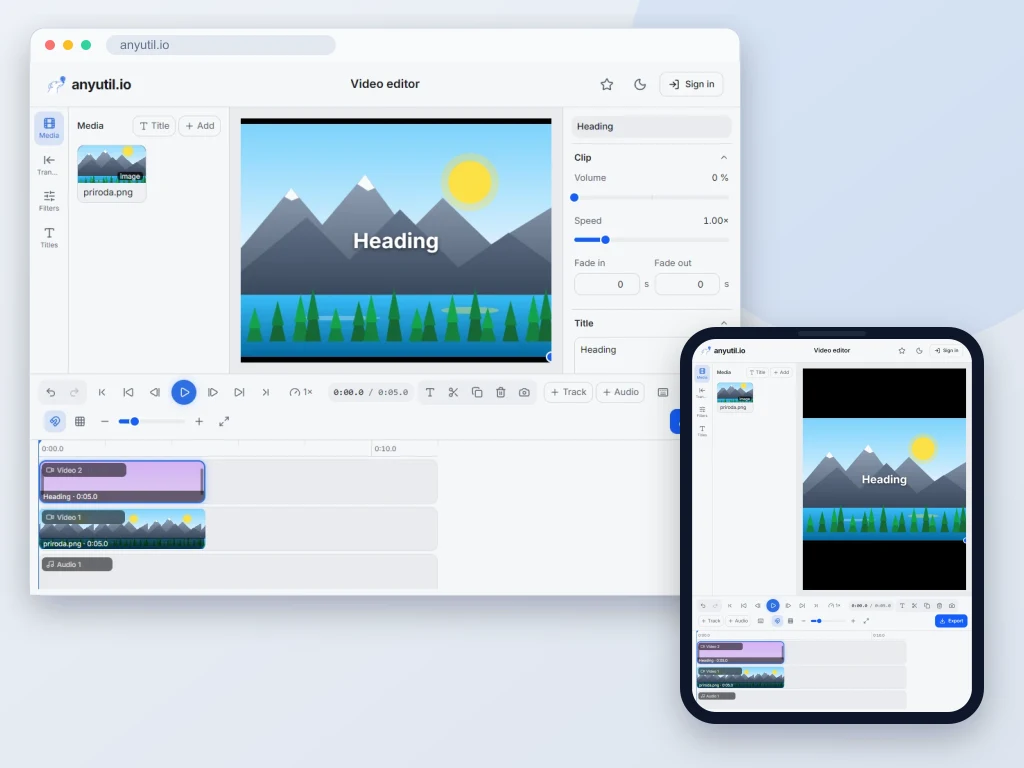
Open full screen
Runs in your browser, your files stay on your computer.
- Runs right in your browser
- Free, no sign-up
More about Video editor
Video editing in the browser, nothing to install and nothing uploaded
The editor works with tracks, the way desktop editing programs do. You lay clips on a timeline, trim them by the edges, split them, add transitions, titles, music and colour grading, and save the result as MP4, WebM, GIF or audio only as MP3. Editing is non-destructive: the original files stay untouched, you only change how the video is assembled from them.
The whole edit and the final render run in your browser through ffmpeg.wasm. Your videos are never uploaded; the one exception is automatic captions from speech, which a server transcribes. The editor is free, needs no account and adds no watermark.
How to edit a video, step by step
- Add your files. Drop video, images and audio into the library. A file can be up to 100 MB for free, or up to 1 GB with a Premium account.
- Lay the clips on the timeline. Video and images go on video tracks, music and voice-over on audio tracks. You can stack several tracks; the upper video track covers the one below it.
- Cut. Drag an edge to trim a clip, press S to split it at the playhead, Delete to remove it. Delete with close gap shifts the rest of the timeline left. Snapping keeps clips flush with each other and with markers.
- Add transitions, titles and effects. Drag a transition between two clips, press T for a title, and use the inspector to set colour, speed, crop or animation for the selected clip.
- Fix the audio. Volume, fade in and fade out, loudness normalisation and automatic ducking of music under speech.
- Export. Pick the format, resolution, frame rate and quality, or go straight to a preset for YouTube, Shorts, TikTok, Reels, Instagram, Facebook, WhatsApp or X. A file size estimate shows before you start.
What the editor can do
Timeline and cutting
- Several video and audio tracks; drag clips between them.
- Trim by the edges, split at the playhead, duplicate, copy and paste, nudge by a tenth of a second with the keyboard, step frame by frame.
- Ripple delete (remove and close the gap), snapping to clips and markers, marquee selection of several clips.
- Markers at the playhead; click one to jump to it. In and Out marks define a range that is exported instead of the whole project.
- J, K and L for playing backwards, pausing and speeding up, plus unlimited undo and redo.
Transitions, titles, stickers and shapes
- 25 transitions: crossfade, fade through black, slides and pushes in four directions and into the corners, fly-ins, wipes, zoom in and out, and a blur dissolve.
- Titles with six style presets (heading, subheading, name tag, captions, quote, shout) and twelve entrance animations: fade, arrival from eight directions, pop, bounce and ride.
- Stickers and shapes: emoji, arrows, circles, rectangles, lines, stars, hearts, checks and crosses, with your own colour, size and rotation.
Animation, crop and colour
- Clip animation: zoom in, zoom out, pan in four directions, Ken Burns for photos, or custom keyframes with a choice of easing (linear, ease in, ease out, both). The motion can start later and last only part of the clip; dragging the picture on the canvas moves the animation along with it.
- A crop for each clip, free or locked to an aspect ratio.
- Colour grading: exposure, brightness, contrast, highlights, shadows, saturation, temperature, tint, sharpen, blur and vignette, plus sixteen ready-made presets from black and white to film and retro looks.
- Chroma key (green screen) with a colour picker on the canvas and controls for similarity and edge softness. The transparency shows only in the export; the preview does not draw it.
- Speed from 0.25x to 4x, reverse playback for sources up to 30 s, and a freeze frame that holds the clip's first frame for its whole length.
Audio
- Volume per clip and per track, fade in and fade out, waveforms drawn right on the timeline.
- Loudness normalisation to a standard level (-16 LUFS): quiet recordings come up, loud ones come down.
- Ducking under speech: music on a track turns itself down whenever someone speaks on the other tracks, with adjustable amount, attack and release.
- Detach the audio from a video into its own clip on an audio track, and a master limiter on the output against clipping.
Subtitles
- Import SRT (and, tolerantly, WebVTT) and download the subtitles back as SRT.
- Captions from speech: select a clip, a server transcribes what is said and the captions land on the timeline as text clips. The audio is deleted on the server after transcription. This is the only part of the editor that leaves your device, and it counts toward the same limit as audio transcription.
- A caption is an ordinary text clip: move it, trim it, rewrite it or restyle it like anything else.
Export
- MP4 (H.264), WebM, GIF (no sound, at most 15 frames per second and 640 pixels wide) and audio-only MP3.
- 480p, 720p or 1080p, 24, 30 or 60 fps, three quality tiers and an aspect ratio of 16:9, 9:16, 1:1 or 4:5.
- Presets for YouTube, Shorts, TikTok, Reels, Instagram square and portrait, Facebook, WhatsApp and X that set the aspect ratio, resolution, quality and format at once.
- Export only the range between the In and Out marks, a file size estimate before you start, and saving the current frame as PNG.
On a phone
The editor works on phones too. Pinch to zoom the timeline, long-press a clip to open its menu. On a phone the editor suggests 720p: you will not see the difference on a small screen and the export takes about half the time. Your project is saved to the browser's storage as you go, and the editor offers to restore it the next time you open the page.
Where the limits are
- Export speed. ffmpeg runs in the browser on a single thread, because the multi-threaded build needs a setting that would break the rest of the site. A 1080p export therefore takes about as long as the video itself, and longer on a slower machine. At 720p it is roughly half that.
- Project length. The export keeps its data in the tab's memory. A computer copes with longer videos; on a phone we recommend clips of a few minutes at most. If all you need is a smaller file or one section cut out, the leaner video compression and video trimming tools are the better fit.
- File size. 100 MB per file for free, 1 GB with a Premium account.
- What is missing. The editor has no noise removal for audio, no object tracking and no automatic background removal without a green screen.
Privacy
Your videos, images and audio stay in your browser. Decoding, editing and encoding the result all happen on your computer or phone; nothing is sent to a server. The one exception is captions from speech: the audio of the selected clip is sent for transcription and deleted on the server afterwards. The project in progress is kept in the browser's own storage on your device, not with us.
Frequently asked questions
Is the editor free?
Yes, all of it, with no account and no watermark. Your browser does the editing and the export, so it costs us nothing we would need to charge for. A Premium account raises the file size limit from 100 MB to 1 GB and removes the daily limit on captions from speech.
Does it upload my video?
No. The editor opens it in the tab's memory and does all the work in your browser. The only thing sent to a server is the audio of a clip you ask to caption from speech, and it is deleted after transcription.
Why is the export slow?
Because your computer converts the video on a single thread, not our servers. Expect a 1080p export to take about as long as the video runs, and longer on an older computer or a phone. Lower resolution helps, so does exporting a shorter range between the In and Out marks, and keeping the tab open in the foreground: browsers slow down work in background tabs.
Which formats go in and out?
In: common video, audio and image files; a GIF is converted to video when added. Out: MP4 with H.264, WebM, GIF and audio-only MP3, at 480p, 720p or 1080p and 24, 30 or 60 frames per second.
Does it work on a phone?
Yes. Pinch to zoom the timeline and long-press a clip for its menu. On a phone the editor suggests 720p, and we recommend clips of a few minutes at most; a longer export can run out of the phone's memory before it finishes.
How do I add subtitles?
Either import a finished SRT file, or select a clip and have the captions transcribed from speech. Both ways they appear on the timeline as text clips you can move, trim or rewrite, and you can download them back as SRT at the end. Captions from speech are computed by a server and count toward the daily audio transcription limit.
Can it remove background noise?
No, the editor has no noise or echo removal. It offers loudness normalisation, a limiter against clipping and ducking of music under speech. Clean a noisy recording in another program and bring the finished audio into the editor.
Can I make a vertical video from a horizontal one?
Yes. Switch the project's aspect ratio to 9:16, or pick the Shorts, TikTok or Reels preset. Then crop the clip in the inspector, or zoom and pan it, so the part that matters stays in frame. One edit gives you a YouTube version and a Reels version.
Will I lose my work if I close the tab?
No. The editor keeps saving the project, files included, to the browser's storage on your device and offers to restore it the next time you open the page. The exception is a private window, where the browser provides no storage. Do download the finished video after exporting: only the project is saved, not the result.
Why can't I see the green screen transparency in the preview?
Chroma key is computed only during export; the preview does not draw it. Set the colour, similarity and edge softness, export a short range between the In and Out marks and check the result in the finished video.
Related tools
- Compress a videoShrink a video to a target size or by quality.
- Remove audio from a videoDrop the sound track without touching the picture.
- Add audio to a videoLay music and voice-over under a video on a timeline, across several tracks.
- Convert a videoMP4, WebM, MKV, MOV, AVI, WMV, MPG, 3GP, FLV, TS and OGV, in your browser.