
Presentation editor
Build a deck and download it as PPTX for PowerPoint.
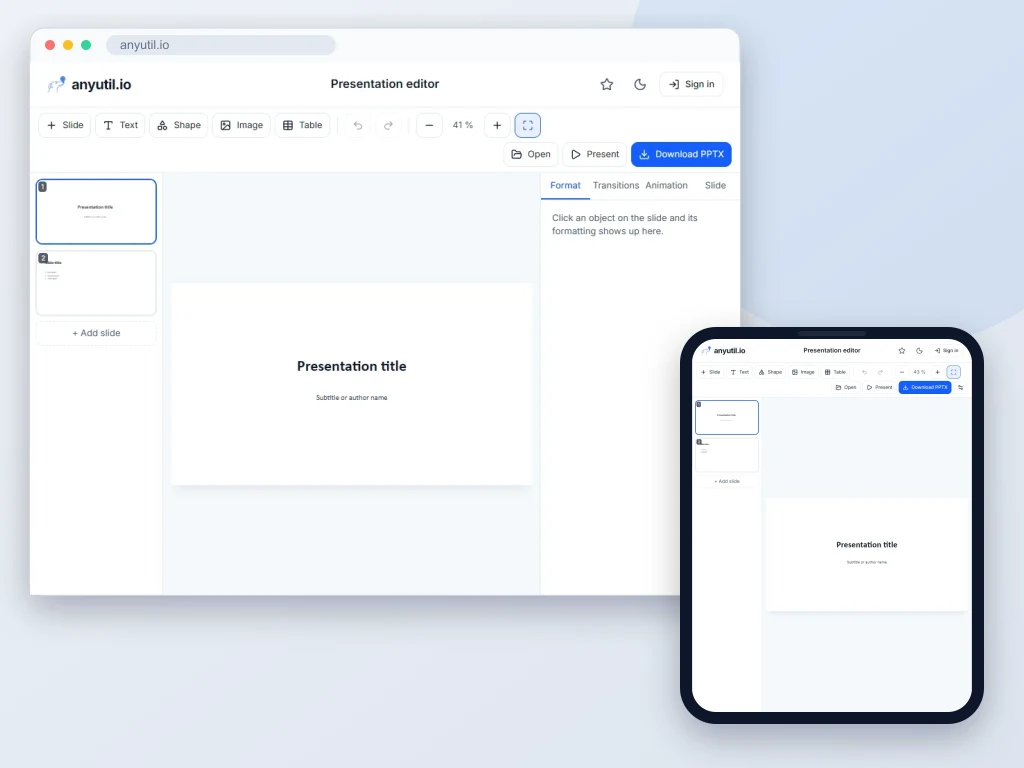
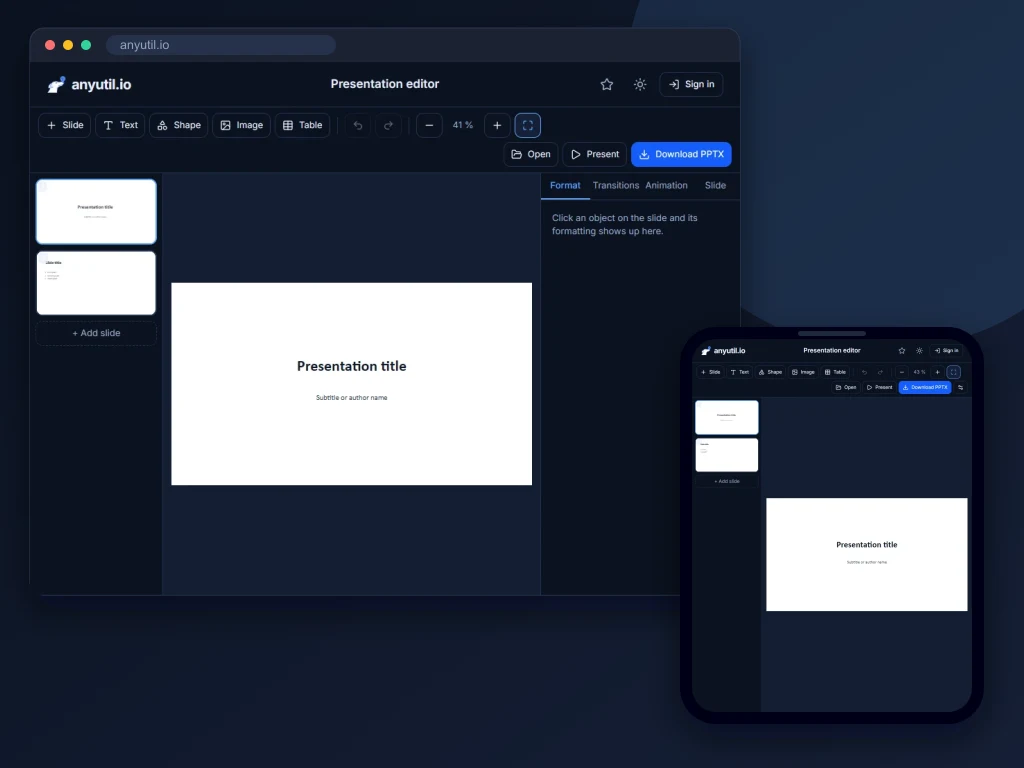
Open full screen
Runs in your browser, your files stay on your computer.
- Runs right in your browser
- Free, no sign-up
More about Presentation editor
How to build a presentation in the browser
Open the editor with the button above. You start with a title slide and add more in the strip on the left, choosing a layout for each. Drop text, a shape, an image or a table onto the slide, grab an object with the mouse and resize it by the corner handles. Download the finished work as a PPTX that opens in PowerPoint, LibreOffice Impress and Google Slides.
- Slide transitions: fade, push, wipe, cover, split, zoom, dissolve or cut, with a direction and a duration. One button applies them to the whole deck, and a slide can also advance on its own after a set time.
- Object animation: every box can make its own entrance, on click, with the previous one or after it. Change the order with the arrows and it plays exactly as it is written into the PPTX.
- Per-paragraph formatting: a heading and a smaller line under it fit in one box. While typing, changes apply to the paragraph the cursor is in; outside typing, to the whole box. Bullets have five levels of indentation.
- Working with objects: select several by dragging or with Shift, group them, align and distribute, layers, locking, copy and paste, duplicate by dragging with Ctrl, snapping to guides and to a grid, flipping shapes and images, shadows, hyperlinks, and copying formatting with the painter brush.
- Charts and icons: column, bar, line, area, pie or donut charts with a data table right in the panel, and an icon library where you pick the colour. Charts go into the PPTX as images.
- Images: crop, brightness, contrast, saturation and greyscale, rounded corners and a border. Paste an image from the clipboard or drop a file onto the slide. Lines can have arrowheads.
- Templates and project files: eight ready decks (company overview, investor pitch, product launch, project status, training session, school report, photo deck) that come with text, tables, charts and speaker notes. Work in progress can be saved as a .json project file and reopened later without losing anything.
- Export: PPTX for PowerPoint, a PDF with one slide per page, or a PNG of the current slide. Hidden slides are skipped while presenting and left out of the PDF.
- Find and replace: Ctrl + F searches text boxes, shapes and tables across the whole deck and replaces every occurrence at once.
- Slide overview: the whole deck on one screen; drag to reorder, duplicate or delete slides with the buttons.
- Editing on a phone: the properties panel slides up from the bottom, two fingers zoom the canvas, holding a finger opens the menu and a double tap starts typing. You can polish a deck on the go.
- Themes: four sets of colours and fonts. Switching the theme recolours headings and text that carried the old theme colours; your own colours stay.
- Presenter view: the P key while presenting. Next to the slide you see the next one, the notes, a timer and which animation step is running. A laser pointer (L) and a pen (D) draw straight onto the slide, and the show can loop.
- Opening an existing deck: a PPTX file can be opened and edited. Text, images, shapes, tables, transitions and animations all load.
Work in progress is kept in your browser's storage, so it survives closing the tab. It does not reopen on its own: the start screen offers it under Continue, next to opening a file and starting a new deck. Nothing is sent to a server, images included.
Keyboard shortcuts
- Ctrl + Z undo, Ctrl + Shift + Z redo
- Ctrl + S download the PPTX, Ctrl + Shift + S save the project, Ctrl + D duplicate an object, Ctrl + M add a slide
- Ctrl + G group the selection, Ctrl + Shift + G ungroup, Ctrl + click picks one object inside a group, Ctrl + ' toggles the grid
- PgUp and PgDn move between slides, Ctrl + mouse wheel zooms the canvas
- Enter types into the selected box, Delete removes an object, arrows nudge by a pixel and by ten with Shift
- Ctrl + C and Ctrl + V copy objects, Ctrl + A selects everything on the slide
- While dragging, Shift keeps the aspect ratio, Alt turns off snapping to guides, Ctrl drags a copy, Shift + click adds an object to the selection
- Ctrl + B, I and U toggle the type styles, Ctrl + F opens find and replace, F5 presents from the start and with Shift from the current slide
- While presenting, P opens presenter view, N the notes, L the laser pointer, D the pen, the space bar advances through the animation steps and on a phone a swipe turns the slides
Frequently asked questions
Will the result open in PowerPoint?
Yes. The downloaded file is an ordinary PPTX in the Office Open XML format, with 16:9 slides, the theme, the notes and the embedded images.
Are the slides uploaded to a server?
No. The editor runs entirely in your browser and the file is assembled only at the moment you download. So you can prepare a deck full of sensitive numbers even on a machine where uploading is not allowed.
Can I have two type sizes in one box?
Yes, each paragraph keeps its own style. Individual words inside a sentence share one style though: mixing weights mid-paragraph would mean writing our own text engine and the editor would get heavy. For one highlighted word, use a separate text box.
Does it do animations and slide transitions?
Yes. A slide can have a transition with a direction and a duration, and every object its own entrance. Both play while presenting and are written into the downloaded PPTX, so they work in PowerPoint too. Motion paths and exit effects are not supported yet.
What happens to a deck I open from PPTX?
Text with its paragraph formatting, images, shapes, tables, colours, transitions and object entrances all load. Formatting of individual words inside a paragraph is unified, and charts do not load. The original file is left untouched, the editor works on a copy in memory.
How large can the images be?
An ordinary phone photo fits. Bear in mind images also go into the browser's storage, which holds around five megabytes, so with bigger decks it is safer to download your work as you go.